
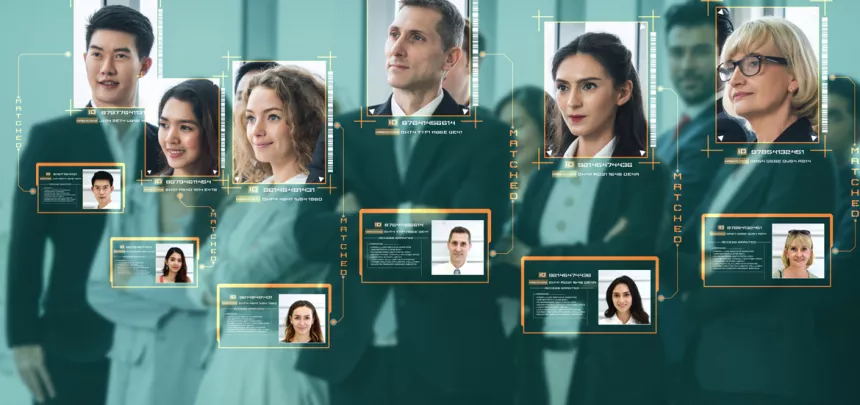
Data and algorithms are transforming the traditional way of selecting employees
Employee selection has also evolved
With the transition to a market economy in the 1990s, the principles and methods of recruiting new employees also began to change. This is a continuous process that continues to this day. While the demands placed on employees are defined quite clearly by the times, recruitment itself is much more variable in this respect. Some HR professionals, for example, consider the traditional résumé outdated and prefer LinkedIn instead. Another group of HR specialists, on the other hand, still strongly relies on the classic CV when selecting employees. Overall, however, recruitment is most influenced by new technologies, which speed up the hiring process while increasing its efficiency.
The rise of new technologies
Technological progress has significantly shaped the way companies search for and assess new employees. Whereas personal impressions from interviews once played a central role, today there is a growing reliance on data and automated processes. Artificial intelligence, automated systems, and other sophisticated tools now play an important role throughout the employee selection process. As a result, recruitment has shifted from subjective impressions toward analytical data processing, where accuracy, measurability, and prediction take center stage.
Employee selection in the 21st century
Although modern recruitment is built on analytical foundations, the human element remains indispensable. The recruitment process in the 21st century therefore combines modern technologies with work psychology. This blend allows HR professionals to connect data models with a deeper understanding of human behavior. This approach represents the most effective path to finding and successfully integrating a new employee. It can be divided into the following areas:
Video analysis, voice analysis, and behavioral prediction
Modern recruitment tools today can do far more than simply compare résumés. They use elements of visual and voice analysis, examining not only what a candidate says, but also how they say it. This enables HR specialists to capture subtle aspects of human behavior that would otherwise often remain unnoticed during employee selection. Video analysis focuses on facial expressions, eye contact, and body posture, using this data to estimate levels of confidence, empathy, or stress. Voice analysis evaluates tone, rhythm, and speech tempo, providing insights into how a candidate responds under pressure or whether they appear trustworthy. These methods are complemented by so-called behavioral prediction, which uses data patterns to forecast how an applicant is likely to behave in workplace situations—for example, how they will respond to change, conflict, or feedback.
AI-first employee selection
When discussing modern HR tools, artificial intelligence cannot be overlooked. Its development has moved recruitment a significant step forward. In the approach known as AI-first employee selection, technology becomes the primary means of evaluating candidates. Some companies even use it as the main decision-making tool. Based on historical data, algorithms can predict candidate success, analyze résumé content, professional network activity, and online test results. The system then automatically ranks suitable candidates according to the probability that they will perform well in a given position.
Intuition and algorithms combined
Even the most advanced technologies are not yet able to fully replace human experience. While algorithms work with vast amounts of data, they cannot recognize certain nuances that are crucial for proper employee selection. These include cultural fit, motivation, or a candidate’s value framework. This is where the recruiter’s intuition and ability to read between the lines come into play. Where technology offers speed and measurability, humans provide understanding and situational sensitivity.